Time is Running Out: What Have You Learned from the Greatest Generation?

May 6th, 2012

I attended ESGR and Rotary events over the past few days where veterans and active duty military personnel were honored.  Both events were conducted with great dignity, and there were two very moving moments.

With 400 people in attendance at the ESGR event, Admiral James A. Winnefeld Jr., Vice Chairman of the Joint Chiefs of Staff, recognized Jeff Falkel for selflessly contributing his unique bullet pens for every attendee in uniform.  Jeff received a standing ovation as the Admiral described how Jeff tragically lost his son in Afghanistan in 2005.  As a Gold Star Parent, Jeff has since devoted countless hours to the Special Operations Warrior Foundation and the Green Beret Foundation.  Jeff is an amazing person who places a high priority on mentoring many soldiers including my son.  I encourage you to read the book he wrote as a tribute to his son – The Making of OUR Warrior: How SSG Chris Falkel Became a Green Beret Warrior and Hero.

At the Rotary event, it was stirring to hear Joseph LaNier, II describe his youth in segregated Mississippi, and Navy service during World II in Iwo Jima and Okinawa.   Joe’s story is powerful, because his absolute candor helps us understand our historical blunders, and how as individuals we can overcome adversity to make a difference for our family, our community, our country and ourselves.  Steffan Tubbs is writing a book about Joe, and I would be willing to bet there is a great deal of mentoring taking place through that process!

Joe’s story reminded me of my dear friend George Callahan.  George was my boyhood neighbor who was a decorated combat veteran of World War II, Korea, Vietnam, and was a former Army Special Forces soldier. He went through paratrooper and Special Forces training at the unprecedented age of 40.  Like Joe Lanier, George is soft-spoken, kind, and polite.  As his wife Trudy still says, “George is a complete gentleman.”

As my mentor, George was positive, optimistic, immensely inspiring, and completely encouraging as I prepared to enter the military many years ago.  One day before I left for boot camp, I eagerly asked my him for advice that would help me in my training. He said he had only two bits of advice: “Choose your friends carefully. You need to work with everyone, but not everyone has to be your friend.”  The other counsel offered was, “Take the bad times day by day. If it’s really bad, take it hour by hour. If it’s really, really bad, take it moment by moment.”  That advice has served me quite well over the years!

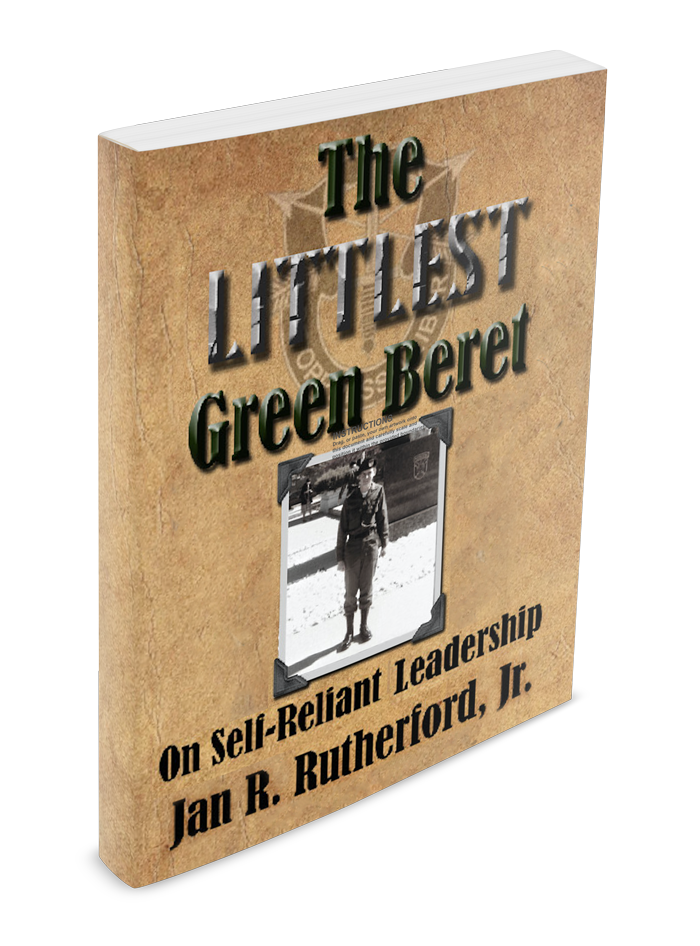
George has a daughter and no sons, so when I earned the Green Beret, I was honored to be presented with one of his cherished berets.  Luckily, my son has also been able to benefit from George’s mentoring, and he will be attending my son’s graduation from West Point in just a few weeks.  George retired as a Chief Warrant Officer, Four (CW4), and will likely be the first person to render a salute to my son when he is commissioned as a Second Lieutenant at Trophy Point.

Mentors are wise and trusted teachers, and there are some great ones out there.  The thing about mentors is that you have to be the one to initiate the relationship.  All you have to do is ask.  In fact, there are still some terrific mentors from the Greatest Generation now in their late 80’s and 90’s.  What have you done to meet them, and gain from their wisdom?  


The Balancing Act – Self versus Collective Leadership

May 2nd, 2012

http://www.thoughtleadersllc.com/2012/05/the-balancing-act-self-versus-collective-leadership/


I’m Just One

April 29th, 2012

When I was twelve years old, my English teacher persuaded me to enter a speech contest.  There were three rules for the contest.  The speech had to be five to seven minutes long, it had to be memorized, and the subject had to be based on the topic, “I’m just one.”  There was no guidance for the topic, but even at twelve years old, we inherently knew that it was about how one person can make a difference in the world.

Two interesting things happened this weekend that made me think about my speech making experience nearly 40 years ago.  I was on my annual guy’s mountain biking weekend out in the desert on the border of Colorado and Utah.  I was with a mix of guys around 50 years old, and sons and friends of sons who were in the early 20’s.  The generational mix got me thinking about the legacy we’re leaving for the next generation, and how fast we’re all burning the non-renewable resource known as time!

In addition, I finally watched the documentary “I am” last night that I have heard about for months.  It did not disappoint, as it was incredibly powerful.  The filmmaker, Tom Shadyac, started out with the two questions:  What’s wrong with the world and what can we do about it?  His short answer, “I am.”  We are.  In the end, much to his surprise, he discovers what’s right with the world.  His answer again is, “I am.”  We are.  The summary of what he found is as follows:

  1. It is scientifically proven that the entire human race is connected.
  2. It is human nature to be cooperative rather than competitive.
  3. If you don’t do what your heart wants you to do and follow your passion, it will destroy you.

Connections, cooperation, competition, and passion are key topics we discuss when debating the tenets of leadership.  What’s old is new again, right?  Excursions into nature always get me thinking philosophically.  I had a 10-mile ride in the desert by myself yesterday amongst mesa’s, giant rock outcroppings, and alcoves.  Places where petroglyphs still stand in testament to questions that have been asked for centuries.  And today, I came across this poem:

It’s 3:23 in the morning and I’m awake 

because my great, great, grandchildren won’t let me sleep. 

My great, great, grandchildren ask me in dreams 

what did you do while the planet was plundered?

what did you do when the earth was unraveling?

surely you did something when the seasons started failing

as the mammals, reptiles and birds were all dying?

did you fill the streets with protest when democracy was stolen?

what did you do 

once 

you 

knew?

Hieroglyphic Stairway by Drew Dellinger

Now that you know, what will you do?  I’m just one…  I am someone who is trying to balance cooperation and competition.  I am someone who is trying to balance ego and humility.  I am someone who is trying to teach the tenets of leadership based on passion, compassion, self-reliance, and collaboration.

The actor Jim Carey summed it up nicely, “What’s the secret of my success? I conquered ego — and that’s what makes me so very special and unique. I have transcended my grandiosity, and that’s what puts me a cut above the rest.”  As just one, what did you need to transcend to make a difference for your team(s)… for the world?


Getting Back Up

April 15th, 2012

I had the good fortune to spend time with the West Point Cycling team again this weekend.  The best part wasn’t that Army won the men’s and women’s ECCC A-Division circuit race on their home turf.  The best part was watching the camaraderie of the team, and seeing that nothing could keep the team down.  Despite crashes and mechanical issues, the focus was always on getting back in the race and competing.  The complete focus was on the team, and completing the race. Even with road rash, stomachaches, colds, and a hairline fracture to a hip, concern for self took a backseat to the needs of the team.  It’s inspiring to see individuals give it their all for the sake of the sport, and the pride of their team.

“Our greatest strength lies not in never failing, but in rising each time we fall.”  –Ralph Waldo Emerson


The Wind and the Leader

April 8th, 2012

I was mountain biking the other day along the Foothills of the Rocky Mountains when I was hit with a sustained wind gust.  It came from the side and almost pushed me off my bike.  At the same time the wind was testing the chinstrap of my helmet, it literally took my breath away for a few moments.  As I was gasping for air, I felt pretty vulnerable.  Afterwards, it got me thinking about an exercise my leadership team conducted where we openly discussed our strengths and weaknesses.  Yes – weaknesses.  We can use plenty of nice terms (challenges, opportunities, growth areas, etc.), but in essence, weaknesses are things  that can derail the progress of a team.  I feel that I have pretty good self-awareness, but as I presented my interpretation of the feedback (“gifts”) I received from my colleagues, I felt like the wind had been taken out of me because I felt completely vulnerable.  The “leadership expert” facing his own hypocrisy!  Here’s the thing – vulnerability when you’re alone tells you what you’re made of.  Shared vulnerability with a team helps create bonds to work with a purpose to accomplish goals.  Be grateful for all the uncomfortable moments, because that’s when you test your character, and how you can use it to make a difference.


What’s Your Number?

March 31st, 2012

Bryan Bungee Jumping!

No – I am not talking about dating or the money you need to retire.  The other day I heard a radio program celebrating their three-thousandth show.  The two deejays have been working together for fifteen years, and I wondered how many shows they would end up doing all together in total.  That is, there is a number at which they will no longer do another show – fini, terminado…

It got me thinking that there are all sorts of activities we do that seem like they’ll go on forever.  A daily run, coaching sessions with employees, strategic planning meetings, etc.  Somewhere in our future, there is a number for all these activities that will be final.  That got me thinking about a fellow in Belfast I’ve had the privilege of getting to know, and first mentioned him in a post I wrote last year.  Bryan Keating is a very distinguished and accomplished gentlemen and he had three mantras that really stuck with me:

  1. The dynamics of enterprise always throws up uncertainties and ambiguities.
  2. Take action sooner rather than later.

And my favorite:

3.  Life is not a dress rehearsal.

I don’t know about you, but I am stepping away from this computer, because I have stuff to do – mostly things that people told me couldn’t be done!


Building the Foundation for a Self-Reliant Team

March 25th, 2012

I recently led a discussion for a group of executives on “The Ethical Leader.”  We discussed six dimensions of leadership decision making as strategic, financial, moral, ethical, cultural, and legal.  Four of the six are directly related to ethical stewardship, so a review of the definitions may be helpful:

Morals – A person’s standards of behavior or beliefs concerning right and wrong.

Ethics – Moral principles that govern a person’s or group’s behavior.

Culture – The values and behaviors that contribute to the unique social and psychological environment of an organization (what is).

Legal – Appointed or required by the law: “a legal requirement.”

What about values?

Organizational Values – The acceptable standards that govern the behavior of individuals within the organization (what should be).

The definitions above contain a great deal of overlap, and are certainly open for philosophical debate, but let’s take a leader’s real-world perspective on ethics and borrow work from Jim Clawson.  He says that Ethical Leadership is based on four cornerstones:

1. Truth-tellingIs it OK for front-page news?

2. Promise-keepingUnder any circumstances?

3. FairnessNot deceiving yourself to think “others” are unreasonable?

4. Respect for the individualPresent and in the moment?

Easy to understand, right?  But remember, these cornerstones are really only tested during crucibles.

Peter Drucker famously said the business enterprise has only two basic functions—marketing and innovation.  That is, get work, and do work.  Towards that end, leaders need to leverage the talents of individuals in a way that people follow willingly.  And people want honest leaders first and foremost.

When you lead without letting “extenuating circumstances” divert you from the four cornerstones – 100% of the time – you will nourish the following characteristics in those you lead:

  • Personal Responsibility
  • Pride in Ownership
  • Self-control/discipline
  • Self-awareness
  • Self-reliance

When you contribute to fully developing your team’s character, you’ll see employee satisfaction, fulfillment and even happiness increase.  It also raises “the acceptable standards that govern the behavior of all the individuals within the organization.”  Enhanced teamwork results along with improving the execution of your vision and strategy.  You see, modeling the four cornerstones strengthens individual and team self-reliance and rewards the ethical leader!


Lead Others To Do Less and Achieve More

March 18th, 2012

Michael Canic wrote a recent blog called “The Zen of Strategy” where he wrote, “Decide what you’re not going to do. Which markets you’re not going to serve. What you’re not going to offer.”  This got me thinking there’s no single trait that’s a more important determinant of leadership success than the ability to unreservedly sacrifice in order to achieve deliberate outcomes for the greater good.

Sacrifice is akin to giving up something in the short-term (e.g., comfort) in order to focus on the task at hand to achieve longer-term objectives.  The act of losing or surrendering something is an important aspect of change that’s often ignored. Only through an intense desire to prefer the altered state will we be ready to give up something.

How often do you take on more and more and still expect stellar results?  Leaders do the same thing with teams and can’t figure out why so many initiatives fail. To focus, you have to prioritize, and to prioritize you have to say no to things as an individual and as a leader.  When teams sacrifice something important, only then are they ready to start to bring new ways to do things into the picture.  Mutual sacrifice is also a trust multiplier.  Ask yourself, “If we start something new, what will we need to stop doing to advance our agenda?”

Canic concluded his blog by suggesting, “Be realistic. Prioritize and focus. Do less, but with greater intensity and heightened expectations.”  What sacrifices will your team need to make on a daily basis to really focus your team?


The Secret Ingredient for (Team) Happiness

March 4th, 2012

“What is the nature of human happiness?”  That’s the seminal question Daniel Gilbert is focused on answering in the latest issue of the Harvard Business Review.   I have heard managers say their co-workers are family, and creating a happy environment is part of the culture.  My question, “Is employee ‘happiness’ a realistic goal for today’s leaders?”

Gilbert’s research thus far shows the things we correlate with happiness (e.g., new house or more money) don’t last long.  In fact, a recent study showed that good or bad events only have about a three-month effect.   That is, we’re good at seeing the silver lining in things no matter how dire they seem at first.  Another aha is that we’re not good at predicting what will actually make us happy – much less those we lead.

Back to my question, is creating happy employees a realistic goal for today’s leaders?  Gilbert found that being bored is what makes people really unhappy.  Creating a challenging environment with stretch goals and rewards works far better than one where fear and anxiety reign.  Another finding is that a person’s social network is the single best indicator of overall happiness.  Given the drive for teamwork, transparency, and innovation, it seems that today’s leaders have much to gain by fostering a highly interactive and social work environment.  Psychologist Ed Diener found that it isn’t “big” experiences that make us happy – it’s many small ones.  In other words, we don’t need to focus on huge reward plans as much as creating a highly social environment where the rewards are simple and frequent – comfortable chairs, a kitchen to congregate, easy to deliver attaboys, etc.

The secret ingredient?  It wouldn’t be a self-reliant blog if I didn’t add in the leader also needs to teach and model personal responsibility.  There is a will power component to happiness that requires a commitment to exercise, meditate, rest and demonstrate benevolence.  William Deresiewicz wrote a short essay called, “Forever Young” where he observed, “Authority, responsibility, sacrifice, discipline, duty, restraint: we no longer know how to value the qualities of adulthood.  The very words are ugly to us. We reject them, because we know, deep down, that we aren’t equipped for them.”

I beg to differ.  The act of losing or surrendering something by sacrifice is a critical component of willpower.  In a recent article in Time on the subject of willpower, Jeffrey Kluger summarized, “fatigue becomes strength and ache becomes commitment.”  Only through an intense desire to prefer the altered state will someone be ready to give up something.  When people sacrifice something important, like precious time, only then are they ready to start to bring new ways to perform.  Chances are, you are comfortable with the way things are today.  Achievement from the status quo requires challenge and discomfort, and as humans, we are geared to conserve energy.  It might be cliché, but great achievements require willpower and sacrifice, but that is also the key to our happiness and that of the teams we lead.


Leadership Lessons from a Veteran of WWII, Korea & Viet Nam

February 20th, 2012

To say there aren’t many people like George Callahan is a gross understatement.  George is 90 years old – a living history book as a veteran of WWII, Korea and Viet Nam.

On February 20, 2012, George sat down with me in a 10-minute interview to answer the following five questions:

1. What was the earliest adversity you faced, and how did it affect your life?

2. What was the best advice you ever received on leadership and why?

3. From a leadership perspective, who has most inspired you and why?

4. What leadership experience taught you the most and why?

5. What advice would you impart for today’s leaders?

George Callahan was my neighbor growing up, and was a decorated combat veteran of World War II, Korea, Vietnam, and was a former Army Special Forces soldier. He went through paratrooper and Special Forces training at the unprecedented age of 40.  When he learned that I had enlisted and signed up for Special Forces training, he invited me into his home where he told war stories and showed me military memorabilia and old photographs. George was positive, optimistic, immensely inspiring, and completely encouraging.

One day before I left for boot camp, I eagerly asked my mentor George for advice that would help me in my training. He said he had only two bits of advice: “Choose your friends carefully. You need to work with everyone, but not everyone has to be your friend.”  The other counsel offered was, “Take the bad times day by day. If it’s really bad, take it hour by hour. If it’s really, really bad, take it moment by moment.”  The end of the interview was cut off, but these two bits of advice are what George reiterated once again.

Through his personal example, George Callahan helped me understand the true meaning of determination and perseverance.